
Recruiting students in Belgium: key figures and trends
by Student
3 mins
Share this article
For decades, student jobs were largely associated with the summer holidays. Students would work for a few weeks in July or August, earn some extra money, and then return to their studies.
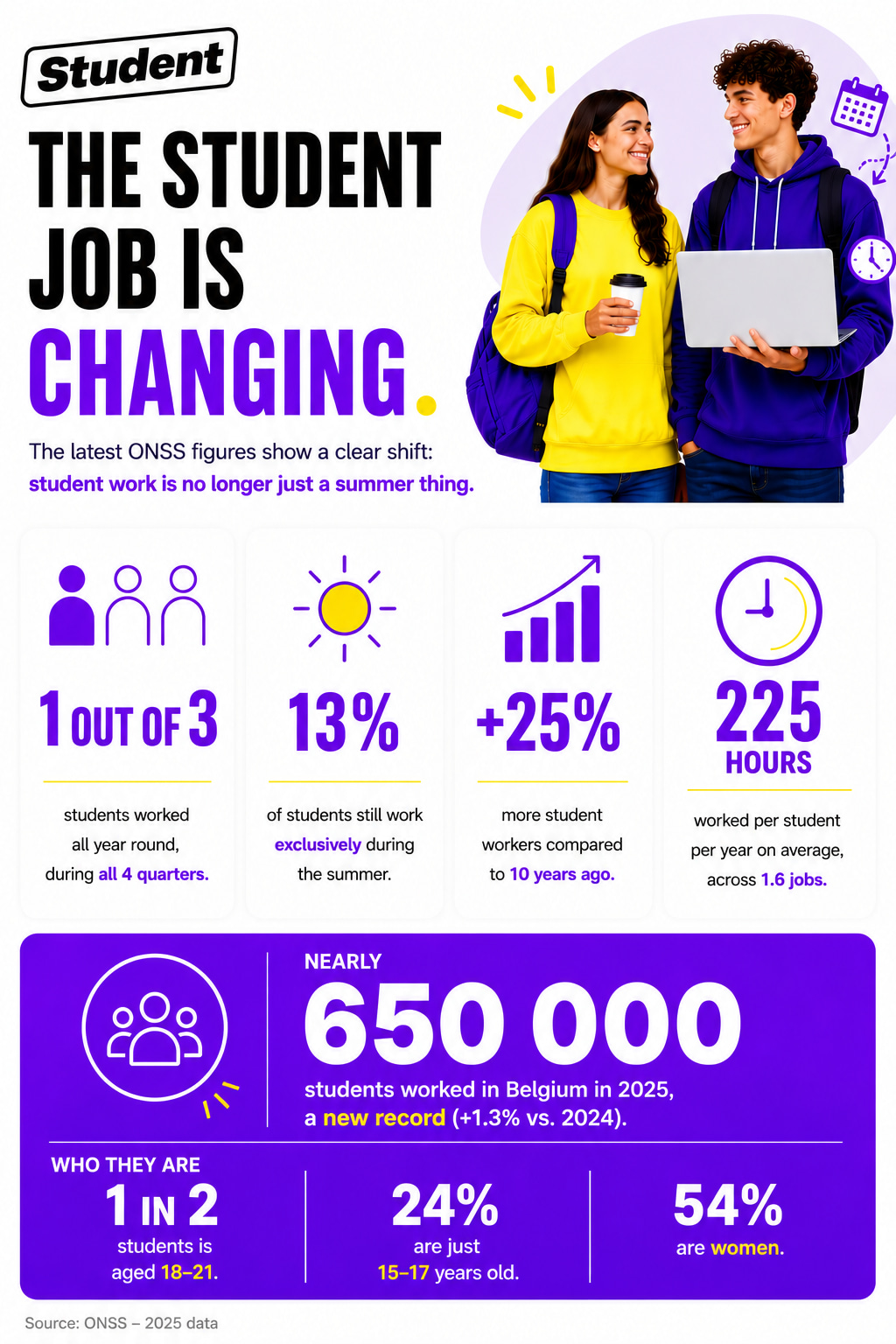
According to the latest figures from the National Social Security Office (ONSS), that model is rapidly disappearing. Today, 1 student worker out of 3 works during all four quarters of the year, while only 13% still follow the traditional summer-only pattern. Student work is no longer a seasonal activity. It has become an integral part of student life.
For employers, this shift represents both a challenge and an opportunity. The companies that adapt their recruitment strategies to this new reality will be better positioned to attract and retain student talent.
Student employment in Belgium reaches a new record
Student employment continues to grow in Belgium. According to the ONSS, 649,055 students worked in Belgium in 2025, representing a new record and a 1.3% increase compared to 2024.
Students are not only more numerous in the workforce. They are also working more hours and holding more positions than ever before. These figures illustrate a profound change in how students approach work during their studies.
Key figures from 2025 include:
- Nearly 650,000 students worked in Belgium
- Student employment has increased by 25% over the past decade
- One student worker out of three worked during all four quarters of the year
- Only 13% worked exclusively during the summer
- Students worked an average of 225 hours per year
- The average student held 1.6 jobs
Who are today's student workers?
The profile of student workers may surprise some employers. While many people associate student jobs primarily with university students, the ONSS figures show that younger students are also highly active in the labour market.
In 2025:
- 38.8% of student workers were aged 18 to 20
- 27.1% were aged 21 to 23
- 23.1% were aged 15 to 17
In other words, nearly one in four student workers is still in secondary education. This is particularly relevant for employers recruiting for entry-level positions, hospitality jobs, retail roles or seasonal work. The available talent pool extends well beyond higher education students.
Recent changes to student work regulations may further increase younger students' participation in the coming years. Indeed, since 2025, 15-year-old students are allowed to work as students under certain conditions.
Students are working more and gaining experience earlier
Student jobs are no longer simply a way to earn pocket money.
The average student worked 225 hours in 2025 and held 1.6 jobs during the year. Many students, therefore, gain exposure to different work environments before they graduate. This early work experience helps students develop valuable skills such as communication, customer service, teamwork, problem-solving, and time management.
Also read: Student launches SnakLab, the video brand built for young audiences
For employers, this means that student workers increasingly arrive with previous professional experience and a better understanding of workplace expectations.
The data also shows that younger students work fewer hours on average. Students aged 15 to 17 worked approximately 140 hours during the year and earned an average hourly wage of €13.20, compared to the overall average of €15.47 across all age groups.
Student recruitment is no longer seasonal
Perhaps the most important takeaway for employers is that student recruitment should no longer be viewed as a summer-only activity.
If one student worker out of three is active during all four quarters of the year, employers who only recruit in summer may be missing a significant part of the available talent pool.
More students are looking for flexible opportunities throughout the academic year, whether for evenings, weekends or recurring part-time schedules.
The employers that recruit throughout the year often benefit from:
- Access to a larger pool of candidates
- Less competition than during peak summer recruitment periods
- Faster hiring when new needs arise
- Stronger relationships with student talent
What this means for employers in 2026 and beyond
The latest ONSS figures confirm a trend that has been building for several years. Students are working earlier, working more frequently, and remaining active throughout the year. Work has become a normal and important part of student life.
For employers, this evolution creates new opportunities to engage with young talent, strengthen employer branding, and build long-term recruitment pipelines. Those who continue to view student jobs as a purely seasonal workforce solution risk missing out on a growing and highly engaged talent pool. The employers that adapt now will be best positioned to attract the next generation of talent.
Looking to recruit student workers, interns, or young graduates in Belgium?
Student connects more than 600 000 students and young graduates with employers across Belgium, helping organizations reach young talent throughout the entire year.







Find other articles per topic 👇
Want to find out more?
Schedule a meeting with us and we'll be happy to show you our solutions and some case studies.